
gemini, help me think
Machines are meant to replace our physical labor. Now, they are “saving” us from thinking, and we let them. As we fall deeper online, does the machine become superior to the human mind?

– 4 min read
Machines are meant to replace our physical labor. Now, they are “saving” us from thinking, and we let them. As we fall deeper online, does the machine become superior to the human mind?

What were the last 3 questions you asked a search engine or AI? Do you remember the response?
Don’t be surprised if you can’t recall. In the modern era, it’s become normal to “search and forget.” When the internet was first introduced, it changed how its users encode information into long-term memory. People expect information to remain accessible online, and, as a result, long-term and complex information gives way to dependence on a simple input-output interface; a phenomenon known as the “Google Effect.” As our capacity for memory seems to regress to an earlier stage of evolutionary development, when exercising thought wasn’t as necessary for survival, I fear memory may not be the only cognitive function at risk. AI appears to amplify the growing decline in our ability to think. In response, many people worry about their jobs being replaced as machines increasingly encroach on the efficiency of organic human cognitive tasks. However, I believe this view of replacement is too tidy a way to describe a deeper reality: the culture of this current era is beginning to believe machine-like cognitive functions are superior to our own.
Historically, as humans have developed technology, we have seen major advances that often substitute for or simplify physical labor: the wheel, the steam engine, and electricity. The internet now contributes to productivity, but unlike mechanical inventions, it reduces cognitive load by making it easier to find information with a simple search. But our relationship with the internet is not just about cognitive shortcuts; we have begun to value the search engine more than the specific facts it delivers. As a result, we are susceptible to absentmindedly exploring the internet, clicking links that take us to topics beyond what we initially sought. Although curiosity often fuels this action, it creates a digital loop: moving from one surface-level source to another without retaining the information we encounter. We slowly lose our ability to have meaningful sustained thought.
The way we have accepted productivity machines in the past, however, often doesn’t apply to AI. Though the internet has been simplifying some of our cognitive functions, the distinction is that, besides AI, other mechanical advancements have preserved human thought because they depend on it to operate. Now, technology like AI requires a bare minimum of human thought to function and delivers high efficiency. As a result, AI can replace some specialized skills regardless of user credentials.
Roughly two decades ago, schools began a gradual shift toward emphasizing “transferable skills” like critical thinking, creativity, collaboration, and communication. However, despite this emphasis, international assessments have raised concerns about declining proficiency in the skills needed to process information carefully. The OECD’s PISA 2025 found that 15-year-olds perform worse at evaluating information and thinking critically about their reading. Moreover, the OECD’s Survey of Adult Skills found that literacy and numeracy skills have stagnated or declined, though numeracy results are more mixed.
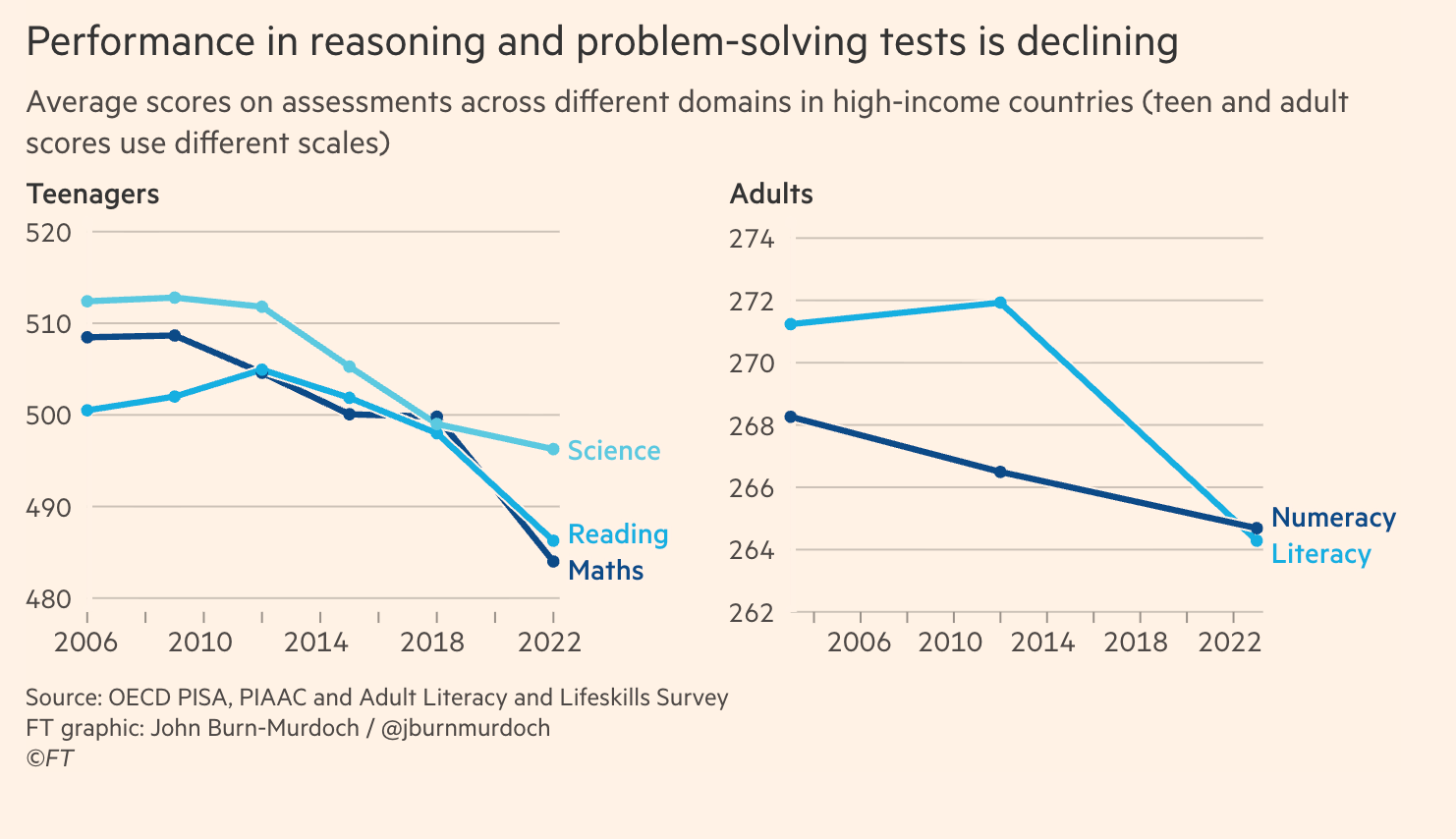
Some scholars, like Daisy Christodoulou, the author of Seven Myths about Education, have pointed out that some of this decline may be attributed to the shift in schools' focus. However, I believe there is more to the picture; larger cultural shifts are happening in the digital era. Nowadays, when students engage with online content, it is often surface-level and lacks deeper meaning. But this also isn’t intentional. Students increasingly encounter fewer everyday situations that require critical and creative thinking skills: scrolling through short-video platforms that keep them hooked for 15 seconds or blindly trusting materials they engage with online. The habits of evaluation and independent reasoning risk atrophy unless they are deliberately practiced. These habits are ignored when a search engine easily supplies facts, an algorithm optimizes capturing your attention, and AI generates human-like language. We are growing accustomed to receiving answers without evaluating them or doing the work of inquiry.
When I Googled “What does it mean to be human?” I received an AI Gemini response: “Being human is a multi-layered journey that mixes biology, consciousness, and social connection.” Although not necessarily wrong, it is a synthesis wrapped in a tidy bow, without including centuries of exploratory thought and attempts to answer a question no one truly knows. It has neatly responded to a universally unanswerable question and removed the cognitive load of cultivating a response of my own.
We have entered a strange time where human thought can seem less necessary than machine output. When students can “Google” something or ask AI to generate it for them, why would they spend their time developing that skill? I don’t necessarily think we should (or can) “slow down” our involvement online, but I do think it’s important to question how much we should shift our lifestyles to accommodate these technological changes.
To be clear, today’s digital technology is not inevitably damaging to critical and creative thought. Instead, it can amplify these skills when used responsibly. However, this boundary is highly contested in the age of the internet and AI. As a new generation emerges into a world filled with engineered distractions that can undermine attention and judgment, we must assign responsibility for preparing these minds.
I believe the educational enterprise must uphold this task. Currently, the educational enterprise seems to be grappling with where to draw the line on electronic exposure in schools, when it should be focusing on how best to harness inevitable electronic exposure to teach students the critical and creative thinking skills needed to succeed in the AI era. In the classroom, removal of electronics can improve student behavior, based on teacher reports. However, in the same studies, educational attainment has, on average, remained largely unchanged even with the removal of devices. Perhaps schools should restrict devices when attention is required for learning, but this is only a limited solution. Students also need structured opportunities to practice evaluating online information, using AI critically, and managing distraction beyond the classroom. Therefore, the solution is not to completely remove electronics from schools, but to foster an environment where technology improves skills instead of hindering them. Otherwise, we have only implemented a short-term solution to a long-term issue.
Ultimately, we are facing systemic cognitive degradation as a consequence of normalizing excessive internet and AI use, preventing the practice of cognitive skills. If we continue down this path of cognitive decline, it becomes easier to believe the machine is superior to the human mind. The challenge we face is integrating new technology so schools teach students to think deeply with it, enhancing human thought without undermining its value.