DanielGuirao Do I Need A PhD To Lift Weights Issue3
0:00
/302.229751
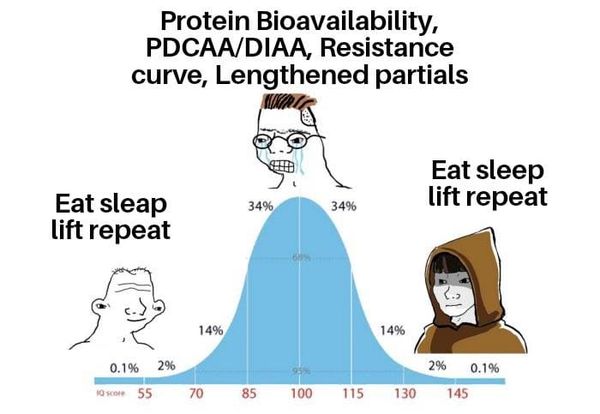
Between the guttural grunting, the mirror-flexing, and the industrial quantities of protein powder, the meathead reputation weightlifting has acquired is certainly deserved. Yet for a hobby associated with meatheads, lifting comes with a surprising amount of homework. To build muscle optimally, you'll need to learn about programming, exercise selection, technique, and a million other things—all of which will probably make you question the meathead stereotype. With my old improvised workout split where I’d pair random muscle groups with one another, I definitely wasn’t doing much to disprove the stereotype. I was doing plenty of things wrong, but I didn’t know enough to worry about them. I loved watching myself get stronger, and there was something euphoric about pushing my absolute hardest and just barely grinding out a rep. But I wonder if I would’ve approached lifting with the same enthusiasm if I’d known how much there was to get wrong.
Over the past few years, creators like Jeff Nippard have popularized science-based lifting: a growing genre of fitness content that uses scientific research to determine which exercises, techniques, routines, and diets are most effective for strength and muscle growth. It’s the opposite of the stereotypical bro-science approach, where gym advice comes from personal experience and whatever the biggest guy in the gym swears by. Thanks to Youtube, Instagram, and Tiktok, what once required digging through research papers now comes neatly packaged into easily digestible videos.
I certainly consume my fair share of it, especially between sets at the gym. The problem is that even experts can disagree on what the science tells us to do. This happened with Jeff Nippard and Eugene Teo, two popular lifters with extensive experience in bodybuilding and coaching. To build more muscle, Nippard advocates for lengthened partials, a technique where you only perform the range of motion where your muscle is stretched. Teo, on the other hand, questions whether the literature supports their effectiveness. Both draw on recent scientific research, yet they arrive at completely different interpretations of what that research actually means for our daily workouts. I’ve been lifting long enough to look into the studies myself and decide whose advice I trust, but that doesn’t mean I always know who’s right.
Where I once knew too little to question what I was doing, I now know just enough to question everything I do.
Don’t get me wrong, in some ways it’s a privilege to be confused by so many people willing to teach you for free—it only costs you attention. Without paying hundreds of dollars for a personal trainer, I can find detailed demonstrations of workouts, often accompanied by explanations of the research behind them. Beginners no longer have to rely on trial and error, nor do they need to interpret dense academic writing, praying that something will work out. I certainly wish I’d had access to some of these resources when I started.
But confusion is only half the problem. What’s arguably worse is the pressure to resolve that confusion before we even begin lifting. Once we know the information is accessible through some bite-sized reel or video, making mistakes starts to feel less like an ordinary part of learning and more like evidence that we simply haven’t done our homework. I mean, if your homework was to watch Youtube for an hour, you’d run home and do it, right? It sounds easy enough, which makes every mistake even harder to excuse. Before the massive surge of science-based lifting content, I could make mistakes without even realizing it—let alone feel guilty about them. Now, the beginner lifter who doesn’t know any better, who barely mustered up the courage to start exercising, becomes perceived as a lazy person who simply hasn't bothered to figure their regiment out.
That’s an unforgiving standard when even the experts don’t have clean answers. How much research is enough before we can stop micro-analyzing our routines and actually start lifting?
I can't promise I'll stop scrolling through gym reels between my sets. But the reason I'm able to sift through the mountain of contradictory advice online without getting overwhelmed is, ironically, because I've made the very mistakes these videos warn beginners against.
I hope that one day, we're able to move into a more measured form of science based lifting: where gymfluencers embrace both their newfound doctorates and their meathead origins.