Imagine opening your phone to a social media app and being greeted by a three-legged shark wearing blue Nike sneakers. Its name is Tralalero Tralala. Scroll a little further and you might find a ballerina with a cappuccino cup for a head, a chimpanzee fuzed with a banana, or a crocodile attached to a military aircraft. Each has a name that sounds vaguely Italian, often accompanied by an AI-generated voice chanting gibberish. There is no obvious reason for any of these creatures to exist. They look like the concoction of a very creative person’s dreams. And yet, children love them. To many adults, this is evidence that something has gone terribly wrong with the younger generation. How could anyone find entertainment in something so pointless? But 160 years ago, another generation of children encountered a world of ridiculous creatures with nonsensical names and conversations.
When Lewis Carroll published Alice’s Adventures in Wonderland in 1865, British children’s literature was still heavily influenced by the moral expectations of Victorian society. The Victorian era placed considerable emphasis on discipline and obedience, and moral instruction was a major purpose of many books written for young readers. Take Aesop’s fables, which originated as a sixth century BCE Greek oral tradition. The collection developed into a globally published phenomenon that peaked in popularity during the British Victorian era through illustrated texts for children’s moral education. In “The Tortoise and the Hare,” a hare loses a race because of his overconfidence, illustrating the value of persistence. “The Boy Who Cried Wolf” teaches us that no one will trust you if you are repeatedly dishonest, even if you finally tell the truth.
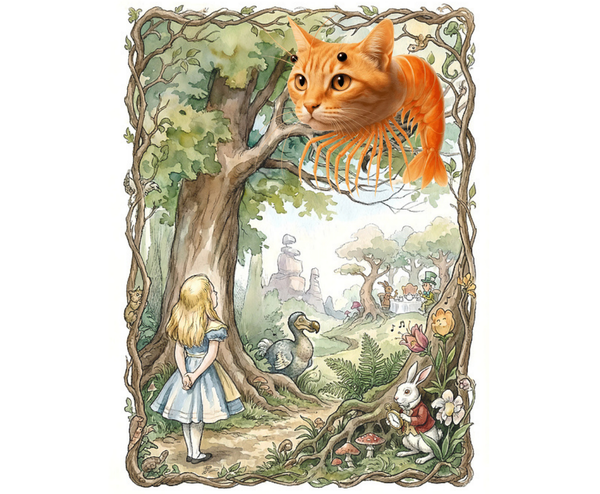
Alice’s Adventures in Wonderland was revolutionary in this context. Alice, a curious little girl, follows the White Rabbit into a seemingly bottomless rabbit hole, where she plunges down past a chaotic collection of miscellaneous household items. Her adventures in “Wonderland” consist of a drink that makes her shrink to the size of a mouse; a cookie that makes her grow 10 feet tall; a Cheshire Cat with a crescent smile; an inquisitive hookah-smoking Caterpillar; a chaotic tea party stuck in a time loop with an eccentric Mad Hatter, March Hare, and Dormouse with sleep apnea; and a Queen of Hearts that threatens “Off with their head!” at the tiniest inconvenience. Finally Alice realizes the absurdity of the world she entered and challenges the Queen’s authority. She declares to the royal army, “Who cares for you? You’re nothing but a pack of cards!”
Lewis Carroll still manages to explore manners and social behavior through his literary work, but he does not attach a straight moral to every encounter. Alice is brave, exploratory, and defiant of irrational adult behavior, qualities that were not usually promoted in children’s books (especially not for a female character). The nonsense of Wonderland allows her the freedom to challenge her Victorian world where rules were strict and unquestionable.
"The nonsense of Wonderland allows her the freedom to challenge her Victorian world where rules were strict and unquestionable."
The new phenomenon of a nonsensical book gaining major popularity among young audiences was not a one-time occurrence and continued long after the Victorian era. Monty Python’s Flying Circus, which aired from 1969 to 1974, featured satirical comedic skits mocking rigid institutions. In its “Ministry of Silly Walks” sketch, government officials are judged for not having ridiculous enough of a walk.
The most recent continuation of this pattern is Italian brainrot. Tralalero Tralala is a shark with sneakers and Chimpanzini Bananini combines a chimpanzee with a banana. Like the Cheshire Cat or the Queen of Hearts, their designs rearrange familiar things into combinations that make no practical sense. A similar comparison can be applied with the six-seven sensation. While it was comparatively short lived—now considered a dead meme—the rapid up-and-down hand movement associated with the two arbitrary consecutive numbers was incredibly popular and reflected a similar leaning towards nonsensical meaninglessness, this time in a world of increasing AI-curated perfection.
While Carroll wrote a sustained story with recurring characters many brainrot videos are short and repetitive, designed for ten-second dopamine boosts to be dissolved from memory ten seconds later. Today’s online world of curated perfection through advertisements or study-with-me videos foster an environment where young people are often told that their time ought to be constantly planned and meaningful. Even our sources of entertainment are judged by the benefit that comes out of it. Watching a proboscis monkey with a leafy mane and giant human feet chant a ridiculous name frees us from the confinement of these expectations.
Alice’s Adventures in Wonderland reminds us that nonsense can offer children room to question the rules and systems built around them and explore their imagination. Brainrot is definitely not the next literary classic, but a child laughing at Tung Tung Tung Sahur does not automatically signal cultural decline. Children have always found respite in what adults might find ridiculous or pointless. Sometimes, absurdity is necessary to liberate the imagination, and to let young ones grow curiouser and curiouser!