That's a Deep Cut!
Why are we so obsessed with being “niche”?

– 3 min read
Why are we so obsessed with being “niche”?
Quick, name a berry!
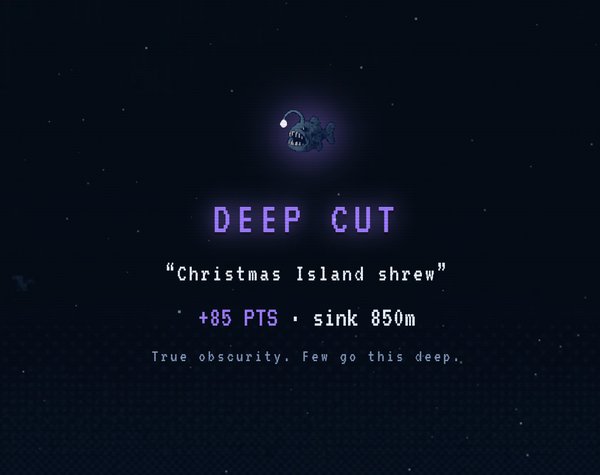
If you guessed “blueberry,” “strawberry,” “raspberry,” or “blackberry,” congratulations: so did everyone else. You gain a measly ten points, your shrimp avatar sinks a pathetic hundred meters, shown as two centimeters on screen. You’re greeted by a pop-up showing your level. It states, “PLANKTON: the answer everyone blurts out.”
If, by some miracle, you blurted out “miracle berry” upon seeing the question, congratulations, for real this time: you struck the jackpot! You gain a hundred points, your shrimp avatar turns golden and sinks a thousand meters—your screen even scrolls to accommodate this astronomical distance. You’re applauded by a pop-up reading “ONE IN A KRILLION: rewires your tongue so lemons taste like candy.”
Such are the mechanics of popular webgame Krillion, in which the player tries to answer seven questions on topics ranging from pop stars to chemical elements. The website proclaims that “rarer answers get more points.”
Krillion explicitly rewards “nicheness.” To our generation, the word has drifted from its original definition—“a place, employment, status, or activity for which a person or thing is best fitted,” according to Merriam-Webster—to mean something unique or unknown. Krillion makes testing your knowledge of obscure topics fun by pairing rare answers with congratulatory graphics and a dopamine hit.
But recently, I’ve noticed my peers taking Krillion’s emphasis on nicheness a little too seriously. “Oh my god, I love your style, it’s so niche” is a compliment of the highest regard. My teacher Dr. Clark told me about a group of sophomore boys who had a lengthy discussion about who in their grade was “the most niche.” It seems niche has become an ideal people seek to embody; conversely, its opposite—mainstream—has become distasteful. I often hear people bragging about how they’ve supported a musician since “before they became mainstream, ugh.”
Why are we so obsessed with being niche?
To many, nicheness feels like a status symbol. Having a unique interest sets people apart from mainstream peasants who aren’t “in the know.” But when more people discover that interest, it can no longer function as a status symbol, and so people pivot away. It is the immaterial form of the aptly named snob effect, which dictates that the demand for certain luxury goods by people with high purchasing power (“snobs”) is inversely correlated with the demand for the same good by people with comparatively lower purchasing power. The niche snobs shun everything mainstream—even if they actually like it—out of fear that it would conflate them with the basic masses.
Perhaps being a niche snob is only natural. As Tim Urban writes, generations Y and Z have constantly been told that we’re different from everyone else, and that it was a good thing. We spent our formative years reading about heroines who were “not like other girls,” being at once “not that pretty” and “striking” while also having the most powerful magic ever to boot—does Y/N ring any bells? We made “Who Am I?” posters at the beginning of each school year. We wrote countless essays about ourselves, from small moment stories in second grade to the Common App personal statement. We fixated on what made us stand out; what made us niche. Those quirks slowly became our answer to the question, “what makes me me?”
But in an increasingly online world, we can see more people than ever. We tend to spend more time consuming content that relates to our own lives. As Ben Smith writes on the New York Times, social media algorithms pushes us content similar to that we’ve lingered on before. And so our digital worlds become inundated with people who have the same hobbies, interests, and therefore personalities as us. Thirty years ago, there’d only be a few emo goths per social circle, and that was their thing. Now, the emo goths from social circles all around the world congregate on Tumblr, where #goth and #emo have 2.5M and 582K followers, respectively. What is their thing, now that they're surrounded by fellow goths?
As such, the quest to become niche can be a search for identity, a way to reclaim our selfhood from our clones on Instagram. In this way, “niche” means something closer to its original etymological meaning: a specialization of sorts, or, more crudely, one’s thing.
At the end of the day, our hobbies and interests are only one facet of our identities. Two people can like the same artists, wear the same clothes, tell the same jokes, and still have completely different experiences, values, and personalities.
Every plankton in the ocean is unique; each of us is one in a krillion.