Sym(a)biosis: Is Human Enhancement Unnatural?
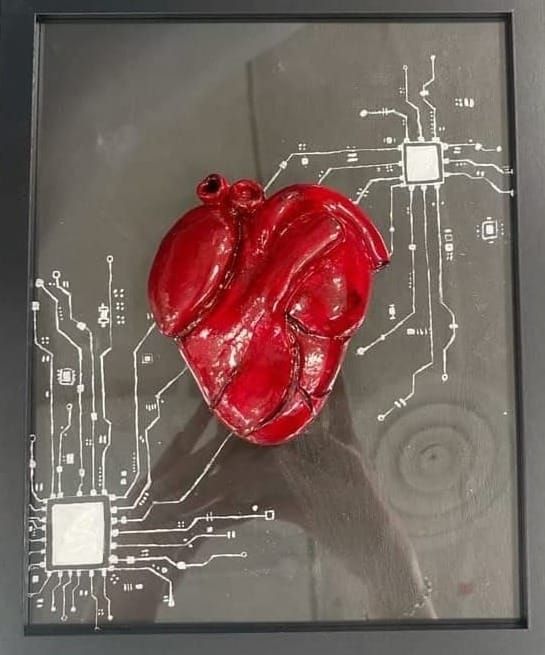
Transhumanists want to merge humans with technology, and critics say that goes against nature. But the urge to go beyond ourselves started long before machines.
– 3 min read
Transhumanists want to merge humans with technology, and critics say that goes against nature. But the urge to go beyond ourselves started long before machines.
Trasumanar—to pass beyond the human. Dante coined this term for the opening canto of Paradiso. The poet stands at the summit of Mount Purgatory, the earthly paradise, with his guide Beatrice. Looking into her eyes he feels himself surpass human limitations and rise towards the heavens. He compares it with Glaucus: the fisherman turned sea god after eating an herb.
Notice Glaucus’ transformation: it happens merely by putting something foreign into his body.
The desire to pass beyond human boundaries is seven centuries older than Neuralink and the rest of Elon Musk's cyborg-esque ambitions. It began as something holy.
For some, it remains sacrosanct. In The Atlantic's “The Case Against Perfection,” political philosopher Michael Sandel argues against artificial genetic enhancement while setting aside familiar objections. Unfair advantages? Some athletes run better simply due to being better endowed genetically than others, he points out; if enhancement was safe and available to all, it would be no less fair than nature. What about inequality? Yes, a split between an enhanced subspecies and the rest of society is a prevalent worry, but not the biggest one.
Sandel is troubled by the attitude beneath casual designer babies. He warns us of the drive to master our own nature, a diminished appreciation of life as a gift to receive.
Our human talents are not wholly our own. Imagine a ballerina. She practices in the studio every day; all of those hours belong to her, right? Because effort is earned and endowment is received? But twin studies blur these boundaries by ascribing the perseverance to practice partly heritable. Basically, X gene codes for Y amino acid, forming Z taste receptor, which—along with thousands of other variants like it—make me prefer a certain ice cream flavor over another. At the gene ACTN3, most people have an arginine codon, and a mutation causes it to be a stop codon instead. Those with two stop codons don’t build α-actinin-3 in their fast twitch muscle fibers (elite sprinters are more likely to have the working version).
I believe that, if enough layers are pulled back, almost all environmental influences expose genetic blueprints. The dancer's intentions grew from predispositions she never chose. If the will to persevere is given, there is little reason to think other human intentions are different, including Dante's, the one he could not put into words: the drive to ascend beyond the human.
The desire to enhance ourselves is not a rebellion against our endowment. It is a constituent of it.
For most of history, life’s genome changed through natural selection unbeknownst to us. Around two billion years ago, one cell swallowed a foreign bacterium and, instead of digesting it, began living symbiotically with it. This bacterium is known today as the mitochondrion (aka powerhouse of the cell). Every thought you’ve ever had—along with anything else that requires energy—runs on this event.
Ten and a half thousand years ago, a few villages in the Near East began keeping wild oxen herds. Generations later, their descendants’ genomes allowed them to digest milk as adults: a change made unintentionally.
Nine thousand years ago, farmers in southern Mexico turned a wild grass into maize, saving the seeds they wanted. They intended a change without knowing genes.
In 2012, Jennifer Doudna and Emmanuelle Charpentier learned how to use molecular scissors to cut DNA. In bacteria, this is used as a defense system that stores information to guide proteins that cut matching viruses. Swap it for your sequence of choice and it will cut there. CRISPR-Cas9 is a change made intentionally and knowingly—a long way from the primordial soup, where the first self replicating molecules could only assemble from what they were given.
Where does receiving end?
CRISPR did not come from outside of nature. It’s a tool borrowed from bacteria, one refined long before us. The lack of a clean line between accepting gifts with humility and mastery does not mean there is no difference. From endosymbiosis to gene editing: what’s changed is the awareness with which we receive. Knowing does not make a gift less of a gift; but we ought to stop acting blindly.
Glaucus metamorphosed beyond himself by merging with a foreign object. Dante rises by looking at Beatrice—admitting he has no words for what is happening.
Both men ascend by accepting strength from outside of themselves.