
Sparta by the Bay
Seniors want to go to San Francisco; Aristotle would like a word.
– 4 min read
Seniors want to go to San Francisco; Aristotle would like a word.
Admissions season is once more upon us, as the more observant have probably noticed. Unexplained phenomena run rampant within our school’s halls, but most curious of all seems to be the single-minded focus of some scarlet-hoodie-wearing seniors on making it big in what is only vaguely referred to as “The Bay”.What even is “The Bay”? What makes it just so special—so special that students barrage it with college applications; flock to it for summer programs; and take mere week-long trips to it yet come back speaking their own special (incomprehensible) language. Welcome to San Francisco. It’s the city of intelligence, and home of various prestigious name-brand universities!
I was determined to uncover the secrets of this magical place, and report back with my findings. Yet, I just couldn’t make sense of it. Why was this city so appealing to us? What should I write about? It seemed weird. It’s filled with hordes of young people, but hardly any old ones. It has almost no children. Its residents don't—at least not in any ordinary sense—work, and they talk about the future in an ambiguously concerning manner. But finally, when I put my pen to paper, it all clicked. Maybe, this wasn’t complicated at all.
Maybe, seniors at SAS simply yearn for the Greek city-state of Sparta.
Sparta was a society that decided, around the seventh century BC, to obsessively optimize and organize itself around the single-minded pursuit of being good at one thing: war. It rebuilt schools, languages, class-systems, and even its own governance to produce courageous foot-soldiers. And, for some three hundred odd-years, it worked wonderfully. San Francisco is like Sparta. The only difference is what it’s chosen instead of war: intelligence.
Take education, for instance. In Sparta, children as young as seven were taken from their homes, and forced into the “agoge”—a quasi-schooling system that deliberately underfed them—so that they would learn to steal. They slept in cramped barracks made of reeds they’d cut themselves. At the end of this tortuous educational experience they applied to a “mess”—a mandatory communal dining club, which citizens had to be a member of to avoid exclusion from society. One vote against you, and you were out.
San Francisco takes them a bit older, but takes them nevertheless. Pushed by venture capital scouts in their schools and the expectations of friends and family alike, they enrol into “accelerators.” Shoved into single-bed apartments in the Bay, they’re given far too little money—half a million dollars, which they call“seed funding”—and told to churn out startup ideas. Hearing of nineteen year old Stanford dropouts prostrating themselves before elite venture capital firms like Y-Combinator, I became convinced that its CEO, Garry Tan, is not so different from the Spartan elders who apathetically inspected newborns and sent the weak ones to the mountain.
The same uncanny similarity is shown in their manner of speech. Phillip II of Macedon once threatened Sparta: “If I bring my army into your land, I will destroy your farms, slay your people, and raze your city.”
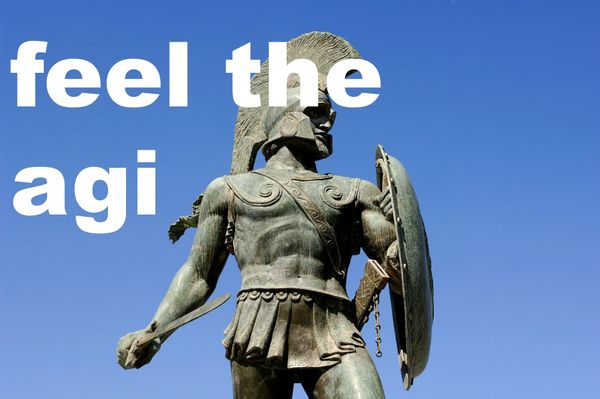
The Spartan reply consisted of a single word. “If.”This concise manner of speech was glorified; they were so proud of it that they even had a name for the brevity: “laconic wit.” In San Francisco, the most honored men write three-word posts on X—”feel the AGI”—and within days thousands are chanting them. But, I don’t intend to be crude. It would be unfair to San Francisco if I made the comparison without giving the city its dues.
San Francisco has far surpassed Sparta in terms of brevity. In fact, they’ve entirely eliminated the need to engage in conversations you’d rather not have! Instead, they rely on far more efficient methods. Discussing the mundane necessities of life has been migrated to the chore list on a shared Notion calendar and the need to endure dreadful social interaction with your family has been jettisoned by personal AI assistants like Instinct and Muse, who can do the heavy lifting for you!
This, of course, raises the question: if not the mundane, what do they do? Spartan citizens never farmed. The historian Herodotus counted seven helots—a word for the state’s slaves—for each citizen. They spent their days farming the fields so that the citizens could train for war. In San Francisco, I was not too surprised to find the same arrangement had been reached. Their physical labor is delegated to those in other countries, nearly all of whom they will never meet. More interesting, however, is the helot they have built for themselves: a thinking machine they train to be smarter every night than it was the night before.
In the very same breath, they describe this helot as terrifying. At one OpenAI leadership retreat, the company's chief scientist built a wooden effigy of “unaligned” AI, and proceeded to set it on fire. He then went back to building said AI. Last month, the CEO of Anthropic posted a four-thousand-word essay titled “We Must Pace the Frontier,” imploring the industry to slow down. Within hours, his largest rivals had agreed. By the end of the week, they went back to showing how much faster the machine had learned. I asked some of my friends there how this was logically consistent. They answered very fast, and used lots of big words, so I assumed it was true. Sparta, too, insisted it wanted peace, yet spent every waking moment fervently training for war.
Aristotle, in Politics II, meekly pointed out a flaw. Sparta had trained its citizens for war, and war alone. Yet, when it finally won—when, in 404 BC, there were no wars left to fight—its citizens had no idea what to do with the peace. Sparta collapsed within a generation.
San Francisco seems to be close to winning its own war. But, if we solve intelligence, what remains?
That seems like a good question for Claude to answer. In the meantime, I take refuge in the fact that our scarlet-laden-seniors will keep on applying to the agoge.