Green Lantern was one of my favourite Justice League members when I was in elementary school. In Injustice: Gods Among Us, his ring could create whatever he imagined: he could make a massive hammer that could smash Batman into the ground; a machine gun that would blow holes into Superman; and a giant jet turbine that would pulverize any hero or villain out of his way. Reading about Green Lantern in comics like Blackest Night and Rebirth, I felt like there were no limits to what he could do.
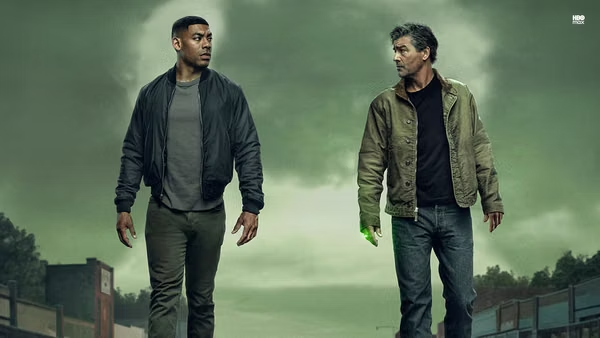
I’d only heard about the new show, Lanterns, when its first episode came out. I went in mostly blind, expecting a cosmic-level conflict. Imagine my shock when Hal Jordan and John Stewart weren’t fighting Parallax or Nekron, but solving a murder as cops in Rushville, Nebraska. Nearly everything that ten-year-old me associated with Green Lantern seemed to be missing.
For avid comic book fans like me, an adaptation is a chance to see a character we've spent years following finally come to life on the screen. It can also introduce that character to an entirely new audience, which is what makes authenticity so important. I truly hoped that Lanterns would capture the same hero I grew up with.
Surprisingly, I still recognized Hal and John. In the first episode, Hal carries out a plan that John has already dismissed as terrible. Rushville's sheriff, Kerry Kane, instructs Hal to not involve himself in the case. Instead, Hal provokes a group of men in a bar, gets beaten up, and waits for the police to arrest him—just so that he can get closer to the suspect. Across the bar, John remains seated, chatting up a girl while his partner gets pummeled in the background. Hal, the rebellious but righteous archetype, deliberately defies orders and breaks the law to get closer to the heart of the murders. He’s courageous and willing to do what’s right, even when the world around him tells him otherwise. John’s disapproval establishes him as Hal’s more disciplined counterpart—someone who's willing to follow orders and put his head down. I felt as if their original, antithetic dynamic was preserved.
After loving the first two episodes of the show, I ventured onto the internet to see what the consensus was amongst critics and comic book fans. To my surprise, they were already criticizing the show for being “unfaithful” to the comics.
If I view Lanterns as captivating and authentic while many comic fans hold the opposite view, what makes a superhero adaptation authentic? Most fans would say that a faithful adaptation should preserve all original aspects of the comics, but it's hard to define what source material to derive from. Superheroes are unique because they exist across decades of contradictory stories and continuities. In Green Lantern #50, Hal was consumed by the loss of his hometown Coast City. In an effort to restore it with his ring, he turns against the Green Lantern Corps, calling himself Parallax. In a newer issue, Green Lantern: Rebirth, Parallax is no longer the moniker that Hal dons after he destroys most of the Green Lantern Corps. Parallax is instead an ancient cosmic entity representing fear who possessed him. This retcon fundamentally changes Hal’s grief and moral failure, reshaping his character as a whole.
If the comics cannot maintain one stable continuity of a character, then "faithfulness to source material” cannot mean reproducing a singular defined version.
No film or show can preserve decades of story, especially when those stories contradict one another.
It shouldn’t matter if the adaptation is set on a fictional alien planet or in the American midwest; the characters should still be recognizable. Which is to say they retain the values, conflicts, relationships, and patterns of decision-making that distinguish them from other heroes. In other words, authenticity should come from preserving a character’s defining qualities.
The grounded approach, though detached from the cosmic background of the Green Lantern Corps, still preserves much of Hal and John’s dynamic. Both lanterns are also uniquely suited to the murder mystery genre because they’re effectively space cops, and it highlights the same themes of institutional authority and rebellion that are central to the Green Lantern mythology.
While Lanterns’ changes still retained the core of its protagonists, Zack Snyder’s Man of Steel, an earlier adaptation for Superman, is less successful. Superman is traditionally a representation of hope and justice who seldom kills. Yet the film repeatedly foregrounds Clark’s destructive capability by portraying him as a threat to humanity, and this culminates in his uncharacteristic decision to kill Zod. Snyder pushes Superman’s heroism and positivity to the background, and the alterations ultimately make him unrecognizable as a superhero.
This isn’t to say that directors should never alter the source material. When done right, changing the genre and setting can still highlight a hero’s unique qualities while producing an authentic and distinctive story. What often goes wrong is the alteration of a hero’s internal logic. At that point, it's a completely different character. The best superhero adaptations, then, aren’t the ones that change the least in pursuit of preserving some idealistic image of a character, but those that understand exactly what can and cannot be changed.