What?
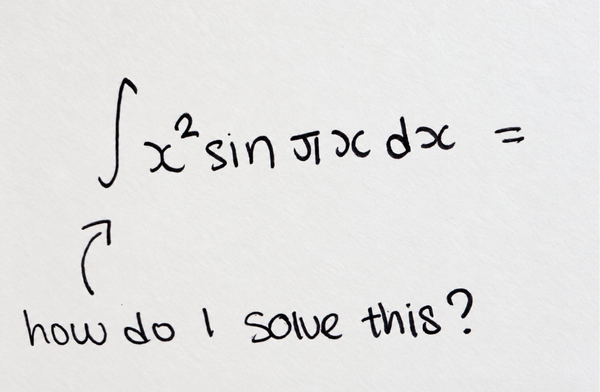
Sitting in my calc class, I was dumbfounded by the integration techniques we had just learned. I stared at the practice problems, unable to pick up my pencil and solve them because I had no idea where to start. “Any questions?” my math teacher happily chirped. Many came to mind: Could you explain that part again? What does that variable mean? Where did that number come from?
Yet, I kept my mouth shut.
I, like many, tend to picture intelligence as getting the right answer on the first try. Smart people don’t guess, and they definitely do not raise their hand to ask about something everyone else apparently understood ten minutes ago. On top of that, we are our own harshest critics when we feel exposed. Named the "Beautiful Mess Effect" , psychologists at the University of Mannheim found that people evaluate their moments of uncertainty, like admitting a mistake or asking for help, much more harshly than they judge someone else for doing the same thing. In other words, we assume that one clarifying question will become the only thing our classmates remember about us for the rest of high school. But this irrational fear lives mostly in our heads, and it hides the fact that raising your hand makes you smarter, not dumber.
Take the popular eight-season medical show House. Its title character, Dr. Gregory House, is a misanthropic medical genius who cracks baffling cases, usually through last-minute epiphanies. In the very first episode, a kindergarten teacher collapses in the middle of a lesson, and with no real proof, House diagnoses her with cerebral vasculitis and puts her on steroids. Although she temporarily loses her vision, House’s medical mishap eventually helps him figure out the correct diagnosis: neurocysticercosis.
House gets to the right answer because he’s willing to say his wrong ideas out loud, in front of people who can test them and argue with him. In the same way, raising your hand and risking an incorrect response gives you the chance to learn through correction. In a 2009 experiment, Nate Kornell, Matthew Hays and Robert Bjork asked people made-up trivia questions. People remembered answers better after guessing wrong than being shown them first, showing that tackling issues–even at the risk of being wrong–leads to better learning. This is the solution to that Tuesday-night frustration: staring at a confusing question at 11 p.m., watching a YouTube video for help, and somehow ending up more confused than before. Asking a teacher costs maybe ten seconds of feeling slightly awkward, and in turn saves you ten minutes of trying to understand how Gemini solved the problem.
There’s also a decent chance that someone near you is relieved that you asked. Contrary to popular belief, asking a seemingly dumb question can make people think more of you. In a 2015 study aptly titled “Smart People Ask for (My) Advice,” Harvard researcher Alison Wood Brooks and her colleagues found that people rated those who asked them for advice as more competent than those who didn’t. They also found that people often hold back from asking because they’re afraid of looking incompetent, which makes the situation a paradox. The fear of looking foolish is clearly exaggerated in our minds, like when you spend five minutes debating whether to ask a question, only for the teacher to casually respond and move on seconds later.
We’ve misread what it means to ask a question, or to get an answer wrong in class. We think it’s stupid when we mess-up in front of everyone, but in reality, that mess up helps us get it right more and more often, and asking can even make our classmates think more of us. So, the next time your teacher asks that familiar question, raise your hand. It’s really not that deep.