
A Response to Common App Prompt 1
Common App Prompt 1: The lessons we take from obstacles we encounter can be fundamental to later success. Recount a time when you faced a challenge, setback, or failure. How did it affect you, and what did you learn from the experience? (650 words maximum)
Nowadays, the news is littered with reports of horror. Ballistic missiles and suicide drones ravage the Middle East, killing thousands while putting stable energy prices and the safe passage of the Straits of Hormuz under existential threat. Russia, which possesses the world’s largest nuclear arsenal, is four years into its bloody invasion of Ukraine. India, the world’s most populous country, trades periodic deadly blows with its neighbor, Pakistan. China’s armed forces, the world’s largest, are being told to be battle-ready by 2027. Growing up in a time when global peace is under existential threat is, to say the least, horrifying.
These challenges pale in comparison to the trials and tribulations that I faced on the fine morning of Tuesday, April 7th, 2026.
The first sign of adversity arrived early. I approached the kitchen sink and turned on my carbonated tap, expecting the usual rush of sparkling water. Instead, the tap gave off a loud screech, followed by a horrid sound of metal gagging, before finally dispensing liquid—uncarbonated, boring, still liquid. I stared at the glass in silence. Sparkling water moves with energy. Still water just sits there. But I drank it anyway, for not every day can start perfectly.
I had intended to nap on the bus ride to school. This proved impossible, for several younger students were playing Minecraft, loudly. Frequent shouts of ‘DON’T BLOW UP MY HOUSE!’ broke through the noise-cancelling filter on my AirPods interrupted any chance of rest. Who knew that children nowadays could construct and destroy entire digital civilizations in the thirty minutes it took to traverse the Bukit Timah Expressway?
School offered little relief. Math was eighty minutes of unsolvable multivariable calculus. The only easily understandable mechanism in that room was the electric pencil sharpener, which happened to stop working that particular day. Integrals on their own are difficult enough. Attempting to use triple integrals to find the volume of a solid bounded by a hyperbolic paraboloid in cylindrical coordinates with a steadily dulling pencil (translation: find the volume of a smashed metal bowl shoved into a pipe; see actual working sketch below) introduced a layer of complexity unacknowledged in modern mathematics.
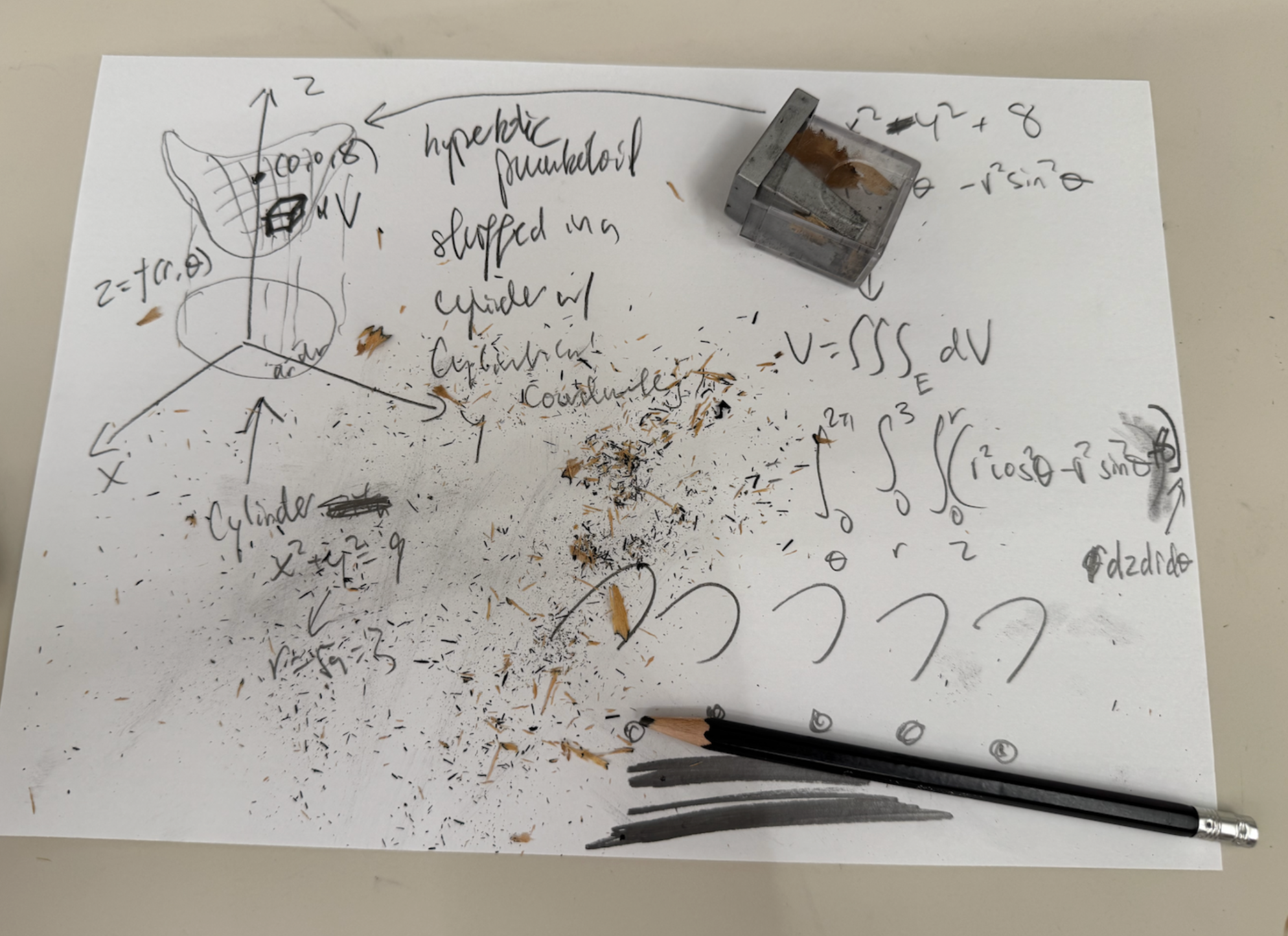
I sharpened the pencil manually.
For lunch, I decided to order a bowl of açaí on GrabFood. In the twenty-first century, food delivery efficiency is expected: after all, Grab is currently experimenting with a drone delivery system in Tanjong Rhu. But not in the Woodlands, where Aziz, my delivery rider, was forty-five minutes away on a folding bicycle.
The bowl arrived in the last minute of lunch without a spoon. But I didn’t need one this time. Forty-five minutes in Aziz’s heated delivery basket had long since rendered my açaí into purple pulp paired with warm banana slices.
I discarded my seventeen-dollar purple smoothie and headed off to Spanish class hungry. Spanish is usually a welcome reprieve: here, instead of partial derivatives, I get to spend eighty minutes comparing and contrasting Panama and Puerto Rico. But not today. The air conditioning broke down.
This is not a trivial matter in Singapore, whose founding Prime Minister Lee Kuan Yew deemed air conditioning as one of the most important inventions for the country’s economic miracle. The comfort it provided enabled basic productivity to function. Without it, offices wouldn’t operate. Learning wouldn’t happen. How could it happen if comparing Hispanic countries in the simple present tense became a sweat-inducing activity?
That sweltering heat clarified something about the challenges we young people face. Our challenges do not resemble the world-ending crises described in the news. After all, history shows that even the gravest conflicts eventually resolve themselves: Nazi Germany and Imperial Japan were defeated, while the Cuban Missile Crisis was settled through diplomacy. These headline-and-history-worthy geopolitical crises typically come to an end one way or another. But the true struggles of high school students do not. No amount of military firepower or diplomatic genius could make Aziz’s two-gear folding bicycle traverse Woodlands Avenue 3 faster. These are the trials that define our lives, and no great statesmen are here to help.
I’ve since tried everything to confront these challenges, including investing in and wearing a $200 pair of FAA-approved noise-protection earmuffs for my early morning bus rides. I am determined to come up with more ideas, some of which may have to be drafted with a manually sharpened pencil.
Later that evening, I read the news. Missiles were launched. Frontlines were shifted. The problems of the world persisted. But so did mine. I returned to the kitchen, turned on the tap, and found that it was still dispensing still water.
And it wasn’t even cold.