D(AI)bolical AI at SAS
Everyone has a wild story to tell about AI at SAS. But if we can outsource our struggle, are we still learning?

– 3 min read
Everyone has a wild story to tell about AI at SAS. But if we can outsource our struggle, are we still learning?
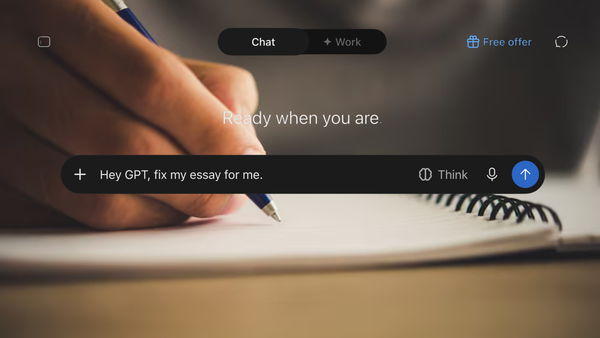
8:03 AM: I’m half-asleep in my first class of the day (senioritis who?) when I hear my teacher announce a new summative. I’m instinctively telling myself to wake up and listen to the instructions when I hear a word that I’ve never heard used in the same sentence as “summative”: AI.
I’ve got to be dreaming. I’m still rubbing my eyes as she goes on and on about how it’s “totally fine” to use AI, down to the em-dashes in the script and Claude-ified presentation visuals.
“So, all I have to do is input a prompt?” the girl next to me asks. I don’t really have an answer for her.
10:21 AM: In my next class, my morning coffee has worn off, and I am struggling to form an outline for my essay. When I ask my teacher for help, he responds cheerily to “Just use Gemini! Our school paid for Gemini Pro for a reason!” By this time of the day, I’m wondering if I have entered an alternate reality.
4:27 PM: I’m chairing an MUN tryout. As I type frantically on my computer, jotting down the performance of each delegate, I hear two peers debating about “the complex tapestry of dynamic biomedical technologies” and “delving— not into the scientific enhancements, but the intricate nuances of medicine.”
4:52 PM: During break, I peek at one of their preparation documents. Unsurprisingly, it is still in the typical LLM formatting, down to the Arial font, dashed page breaks, and bolded subheadings. As my eyes scan the top of the page, I can’t even pretend to be shocked when I see “Certainly 😊! I can give you the specific events, scripts, and rebuttals in a debate about biomedical technologies for the delegate of Russia.” ChatGPT is using emojis now?! Even my after-school club full of self-proclaimed history nerds has transformed into Claude arguing with Claude.
Even my after-school club full of self-proclaimed history nerds has transformed into Claude arguing with Claude.
So, when someone launches their weekly “I love AI” spiel in the cafeteria, I can only react with, at most, a well-intentioned side-eye. Learning—for both teachers and students—cannot be optimized if another person is constantly interjecting and trying to feed you the “right” answer. In fact, SAS’s own student handbook and academic integrity policy state that they wish for students to be “assessed on their own learning”, which also means “doing your own writing.” Especially in English classes, it’s difficult to improve the precision or quality of your writing if AI is in a constant confirmation bias-riddled loop of making your pieces weaker: vagueness is reinforced with more vagueness, and an unaligned argument often becomes more unaligned with the hand of a trusty Claude click.
The other problem with writing at SAS is that many teachers place regulations on AI writing but bend the rules for AI ideating. In the 3 years and 10 months since ChatGPT launched, I’ve heard hundreds of versions of “Use AI to help ideate!”— an act that, when indulged, somehow always manages to lead to an initial AI draft… then some tweaks with the help of AI…then an edited AI version… you get the idea. By the time the piece is complete, “delving”, “colorful tapestry”, “pivotal”, and “realm” have become enshrined terms in our vocabulary. I’ve learned that this tendency is due to AI’s programming: to generate the most common and most predictable word after the previous one, causing the flattening of student (and sometimes, teacher) writing.
Of course, some students at SAS are staunch anti-AI indulgers; they frequently express their frustration at how integrated AI seems in our learning. It seems that as much as we might have become overreliant on AI, few people at SAS want to be dependent on it. What we don’t realize, though, is that for both teachers and students, this dependency is warping our sense of learning. Don’t understand how to get that sophistication point? That’s because it’s an advanced course that requires learning that comes from failure. And that research paper? Yeah, it’s supposed to be developed through inquiry of existing publications, not through DeepSeek’s generative services. For many of us, because of AI, the concept of grappling with something is now a faraway, distant idea. In this avoidance, however, we’re only harming our own intellect; a recent MIT study found that regular ChatGPT users “consistently underperformed at neural, linguistic, and behavioral levels.”
Wrestling with AI at SAS daily over the last four years has taught me an unexpected truth: learning is supposed to be difficult.
Wrestling with AI at SAS daily over the last four years has taught me an unexpected truth: learning is supposed to be difficult. It’s supposed to be a recursive process—for both students and teachers. It’s supposed to test you, to annoy you, or even to frustrate you. Because at the end of the day, learning, in its most stripped-down, fundamental form, teaches critical thinking and content knowledge. But, as SAS’s integrity slideshow says in bold letters, it also teaches you to “trust your own intellect.”
Not doing so, frankly, is d(ai)bolical.